In discussions about whether AI could possibly be conscious, some find the idea absurd while others think it's just around the corner. The difficulty with coming to consensus derives from our lack of a way of reasoning about whether AI can be conscious or not. All we can do is fall back on intuitions based on unspeakable assumptions about something deeply mysterious. We can't easily move forward. There is no way to prove that anyone is conscious besides yourself, you have to make the inferencial leap that you're conscious, and other humans are built like you, so they're likely conscious, too. But that's not a proof. Consciousness is inherently subjective, so proof is hard to come by, thus we are get more stuck when trying to reason about this topic than we do for other topics.
Despite this impasse, progress can be made. You are able to work probalistically about your neighbor's consciousness, even if you don't have a proof.
And this is the spirit of the AI Consciousness Calculator. Based on a method described by Butlin, VanRullin, Chalmers, and others, it estimates the likelihood of any given AI system being conscious, based on your personal views about what consciousness is, how it works, and what its essential features are. You won't get a proof of anything, but you will get a synthesis of your own intuitions about the nature of consciousness and the way those intuitions are realized (or not) by AI systems. It's fuzzy-math in, fuzzy-math out, and perhaps that's the best we can hope for in lieu of the missing formalizations that hinder more concrete forms of progress.
So how do you measure AI consciousness? We can lay out all the different factors that you believe (or don't) are necessary for a system to be conscious, put them next to each other, and combine them—sort of like a Bayesian network, into one estimate of the likelihood of any given AI system being conscious. That's what this calculator does.
We Start Out With a Stance
What is it that would make something conscious or not conscious?
You might think that it's all about the computation that's being done. It doesn't matter what the substrate is, whether it's wet neurons, or whether it's transistors, or whether it's beads on an abacus. Anything that carries out the same computation as our conscious brain will also be conscious. With the consciousness calculator, you can dial in how true you think that is, rather than taking an absolute stance. The likehood you assign to that to feed into the later calculation of our estimate of any given AI system being conscious.
After this question—is it the computation that makes something conscious?—we can also ask: what is important about the physical structure? Not computation itself, not the inputs and the outputs, but is there something about the way that the matter is arranged that carries out those computations that's important? We don't think that's critical, then we can dial it down. We can say it's all about the computations, not really about the computational structure.
Now, what about life? Does something have to be alive to be conscious? Whatever your definition of alive is, you can use that definition, because we're talking about your own stance. Later, that stance, too, will be applied to individual AI systems.
A couple more questions:
Does there have to be one persisting subject of that aliveness? Or could the aliveness be distributed like in a slime mold or an ant colony? If an ant colony in your view could potentially be conscious as an entity, then you don't need one persisting subject.
If a system said that it's conscious, and did so against the literal text used in its training corpus, how much does that impact your view that it might be conscious?
Together, these likelihood estimates define your stance about what it takes to be conscious.
Applying That Stance to Individual AI Systems
Now, we can talk about different AI systems and whether they align or don't align with your stance on consciousness. Let's talk about the transformer network—the network behind all of our current state-of-the-art LLMs, for an example.
There are a number of theories about consciousness that can be measured against both your stance and the properties of an AI system. One example is Algorithmic Recurrence, which states that a system must use feedback and recurrent processing in order to generate consciousness, and which is present or absent in Transformer networks depending on exactly how you interpret it. If your statce dictates that the structure of the computing machinery is part of what is responsible for consciousness, and you believe transformers lack algorithmic recurrence (a structural property), then these factors will lower your overall likelhood estimate that transformers networks can be conscious.
Similarly, do transformers have integrated perceptual representations? Do they have attention? Do they employ predictive coding or predictive processing? Agency and embodiment?
And finally, if a transformer-based system claimed to be conscious even when these claims are absent from its training data, would that be evidence of consciousness?
A Summary Likelihood Score
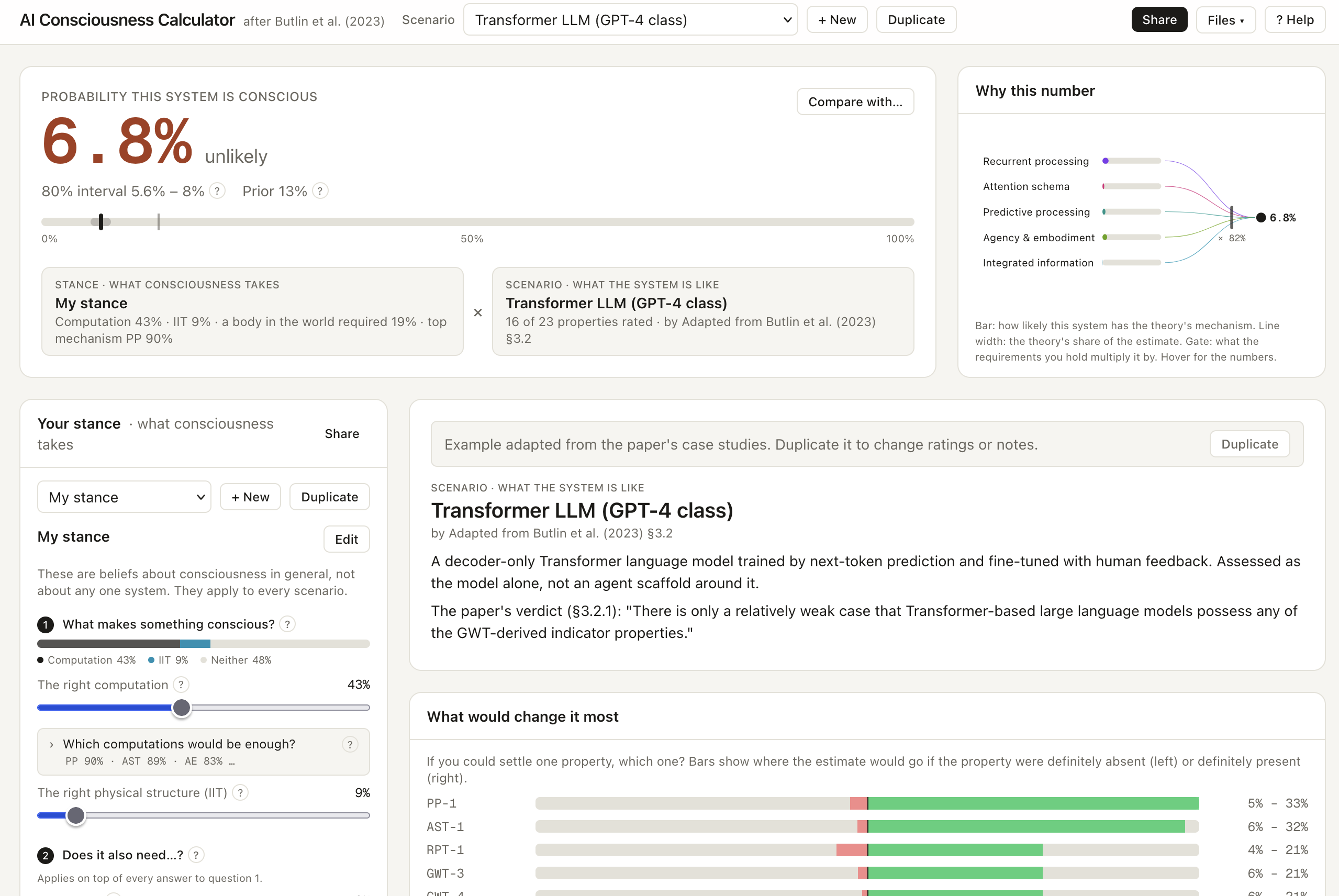
We can go through this exercise for a number of stance questions and system factors. At the end of the process, the calculator computes a likelihood score that the given system is conscious or not. With the numbers that we've chosen, we get a likelihood score of 1.5%—it's fairly unlikely that transformers are conscious.
We can get a sense of what's contributing to that score through this combination computation process in the calculator, using the "Why this number" and "What would change it most" panels.
Why
Soon I will write a little bit about why you want want to estimate the likelihood an AI system is conscious. I'll link to that from here when I do.